Same Price per kW, Very Different Systems: 9 Things to Check in a Rooftop Solar Quote
Rooftop solar has gone mainstream in Coimbatore. More homes in our district have installed rooftop solar under the PM Surya Ghar scheme than anywhere else in Tamil Nadu. Now that the state’s own rooftop solar subsidy has been added to the central one, many more families are getting a rooftop solar quote this year.
That’s good news. But it also means more installers, more quotes and more confusion. Most homeowners line up two or three quotes, look at the price per kW and pick the cheapest. The trouble is that two 3 kW quotes at the same price can describe very different systems. One quietly performs for 25 years. The other starts giving trouble after the first monsoon.
We’ve been installing rooftop solar for over a decade, on residential, commercial and government projects. Here are the nine things we’d check if we were in your shoes, whoever you end up choosing.
In this guide
1. The exact panel brand and model, not just “Tier 1”
A good quote names the panel manufacturer, the model number and the wattage of each panel. Be careful with phrases like “Tier 1 equivalent” or “premium panels”, because they commit to nothing.
Ask for the datasheet and check three things:
- Wattage and count. A 3 kW system might be six 540 W panels or five 600 W panels. Both work, but you should know which one you’re paying for.
- Technology. Today’s panels are mainly Mono PERC or TOPCon. TOPCon is the newer technology and is slightly more efficient. Either is fine, but the quote should say which one you’re getting.
- Subsidy eligibility. To get the government subsidy, your panels must use Indian-made cells (often called DCR panels). If the installer is promising you the subsidy, the panels on the quote must qualify.
Most reputable panel makers give a long performance warranty, often 25–30 years. That warranty comes from the manufacturer, so the brand matters more than the installer’s promise.
2. The inverter: brand, size and type of system
The inverter is the brain of your system and usually the first part to need attention. Check it as carefully as the panels.
- Brand and warranty. Check how long the manufacturer’s warranty lasts and whether there’s a service centre in or near Coimbatore.
- Sizing. The inverter should match your panel capacity. A badly matched inverter wastes generation on sunny afternoons.
- Monitoring. Ask whether the inverter has an app or Wi-Fi monitoring so you can see how much power it generates each day. Watching that is the easiest way to catch a problem early.
On-grid
What most city homes need. It works with the TNPDCL grid and net metering, and it’s usually the most cost-effective option.
Hybrid
Adds batteries for backup during power cuts. It costs more, but it’s worth it if outages are frequent where you live.
Off-grid systems make sense mainly where there’s no reliable grid at all. The subsidy applies to on-grid, hybrid and off-grid systems, so choose based on your needs. A good installer asks about your power cuts and usage before recommending one.
3. The mounting structure: the part nobody looks at
Your panels sit on a steel or aluminium structure for 25 years, through every monsoon. Yet quotes often describe it in one line.
This matters more in Coimbatore than in most places. Winds through the Palakkad Gap can be strong, especially from June to September. A structure that’s fine in a sheltered city may not be fine on an exposed terrace here.
Ask:
- What material is it (hot-dip galvanised steel, pre-galvanised steel or aluminium), and how thick?
- Is it designed for the wind load at your site, or is it a standard kit?
- How is it anchored? Will it affect your roof’s waterproofing?
- How high off the roof will the panels sit? A little clearance keeps the panels cooler and makes cleaning easier.
4. Earthing and lightning protection
Earthing protects your home, your appliances and the system itself. It’s also one of the easiest places to cut corners, because you can’t see it once the work is done.
A good installer will tell you how many earth pits they’ll dig and what type of electrode they’ll use. Most importantly, they’ll measure the earthing resistance after installation. Ask what reading they aim for and whether they’ll show it to you. Our team targets below 8 ohms and keeps adding earth rods until the site reaches it. Also ask whether a lightning arrester is included, especially if yours is the tallest building around.
5. ACDB and DCDB: the most important part after the inverter
After the inverter, the two distribution boxes are the most important part of your system, and the part quotes skip over most often. The DCDB sits on the panel side and the ACDB on the grid side. Together they hold the fuses, breakers, isolators and surge protectors that stop an electrical fault from becoming a fire or a burnt-out inverter.
These switches have to work every single time, for 25 years, in rooftop heat. So the quality of the switchgear inside matters more than the box itself. Ask:
- Which brand of MCBs, fuses, isolators and surge protection devices is used inside each box?
- Are the DC components rated for the voltage of your panel string?
- Is the box itself weatherproof and suitable for outdoor use?
If the quote just says “ACDB/DCDB included”, ask for the switchgear brands in writing. Cheap, unbranded switches are one of the most common reasons for trouble after installation.
6. Cables and conduits
Solar DC cable is made to handle years of direct sun and heat. Ordinary house wiring isn’t. Ask what type and size of cable will be used and how it will run across your roof. It should sit in UV-resistant conduits and be neatly clipped down, not lie loose on the floor where it will crack and get stepped on.
7. Panel placement and shading
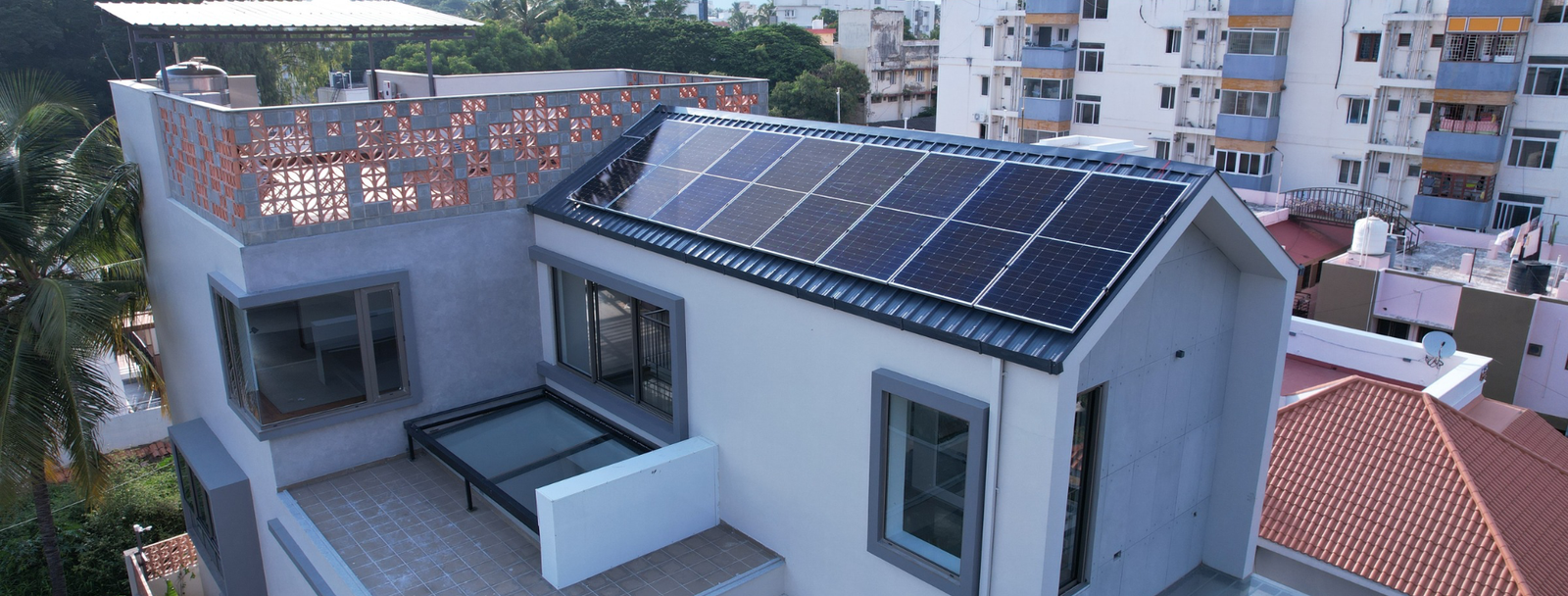
In Coimbatore, panels generally do best facing south with a gentle tilt. But your roof has its own quirks: a water tank, the stairwell roof, a parapet wall, the neighbour’s second floor, or a coconut tree that will be taller in five years.
Shade on even part of one panel can pull down the output of a whole row of panels. A good installer visits your roof, checks the shadows at different times of day and explains the layout before quoting. If someone quotes without seeing your roof, that’s a red flag.
8. Paperwork: who does it, and what’s included
Going solar involves a fair amount of paperwork:
- registering on the PM Surya Ghar portal
- getting a feasibility approval from TNPDCL
- getting a net meter from TNPDCL
- the inspection
- claiming the subsidy after the system is switched on
Some homeowners also want a bank loan. Ask the installer, in writing:
- Will they handle the TNPDCL (TNEB) application and net meter installation?
- Will they upload the documents for your subsidy claim?
- Can they help with a bank loan if you need one?
- Are any fees (such as the net meter or application charges) extra, or already in the quote?
No one can guarantee your subsidy
The government decides the subsidy amount and timeline, not the installer. Be wary of anyone who promises you either.
9. After-sales service
Solar is a 25-year relationship, not a one-day installation. Before you sign, ask:
- Who do I call if generation drops? Is there a local service team?
- Which warranties come from the manufacturer, and what does the installer itself cover?
- Do you offer periodic cleaning or health checks?
- How long has your company been around, and will it still be here in ten years?
A quick checklist to take with you
| Ask about | A good answer sounds like | Watch out for |
|---|---|---|
| Panels | Brand, model, wattage and datasheet named | “Tier 1 equivalent”, no model number |
| Inverter | Named brand, matched size, monitoring app | Size not stated, unknown brand |
| System type | Recommended after asking about your usage and power cuts | Batteries pushed on everyone, or never mentioned |
| Structure | Material, thickness and wind-load design explained | “Standard structure” with no details |
| Earthing | Number of pits, resistance measured and shown | No mention of earthing in the quote |
| ACDB/DCDB | Switchgear brand named for every breaker, fuse and SPD | One line: “ACDB/DCDB included”, no brands |
| Cabling | Solar DC cable in UV-resistant conduit | Ordinary wire, no conduit |
| Site survey | Roof visit and shading check before quoting | Quote over phone or WhatsApp only |
| Paperwork | TNPDCL, subsidy and loan support spelled out | “Subsidy guaranteed” promises |
| Service | Local team, clear warranty split | No clear contact after installation |
How we do it at Cascade
Cascade has manufactured water heaters in Coimbatore since 1984, and we’ve been installing rooftop solar for over a decade. We do a few things differently because we’ve seen what happens when they’re skipped:
- ✓We manufacture our own support structures, designed for the wind load at each site.
- ✓We build our own ACDB and DCDB boxes in-house.
- ✓We measure earthing resistance on every job and add earth rods until we reach our target.
- ✓We install Tier 1 panel brands and name them on every quote.
- ✓We handle all the TNEB/TNPDCL paperwork, help with your subsidy application and can help arrange a bank loan.
- ✓For larger commercial projects, we offer a free energy audit before quoting.
Whoever you choose, take this checklist with you. And if you’d like a quote that answers every one of these questions upfront, talk to our solar team.
Frequently asked questions
Is the cheapest price per kW the best deal?
Should I choose an on-grid or hybrid solar system?
Can any solar installer help me get the government subsidy?
Ready to compare quotes?
Get a detailed rooftop solar quote that answers every question on this checklist.
Get a Solar Quote